
Kyiv Endures Overnight Barrage as Zelensky Heads to Peace Talks

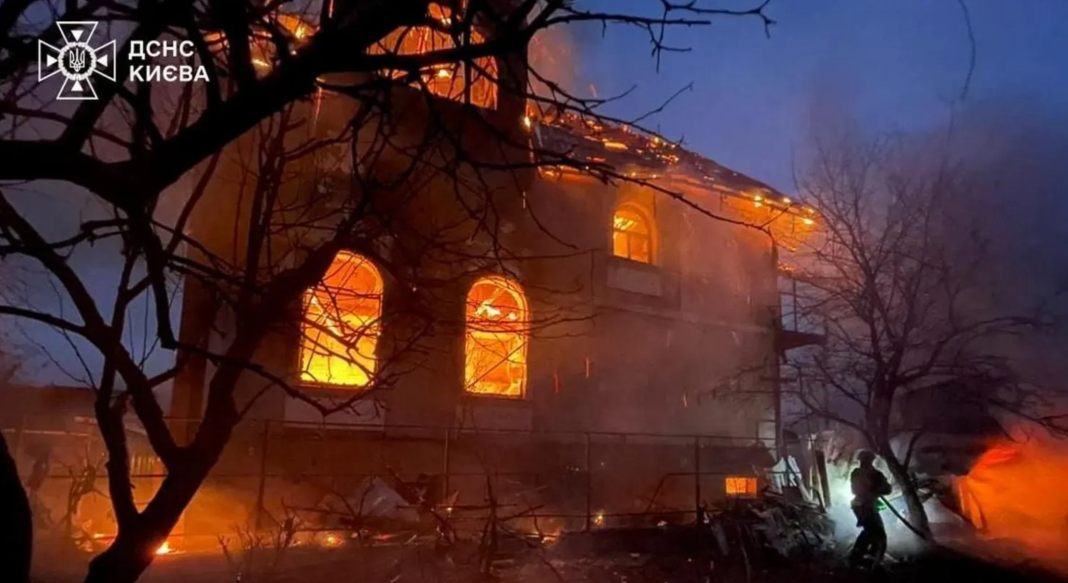
Kyiv — Russia launched a prolonged missile and drone attack on Ukraine’s capital overnight, killing two people and injuring at least 32 others, Ukrainian authorities said on Saturday, as President Volodymyr Zelensky accused Moscow of undermining peace efforts.

The assault lasted nearly 10 hours, with waves of drones and missiles striking Kyiv and surrounding areas. Ukraine’s Minister for Development Oleksiy Kuleba said damage to energy infrastructure left about 40% of residential buildings in the capital and nearby districts without heating.

Ukraine’s State Emergency Service said 68 residents were evacuated from a retirement home in the eastern Darnytskyi district as a precaution. Images from the city showed apartment buildings with gaping holes, scorched facades and fires burning in residential areas.

Writing on Telegram, Zelensky said Russia had launched almost 500 drones and 40 missiles, targeting both energy facilities and civilian infrastructure. He said the attack showed that Moscow was not serious about ending the war.

“Russian representatives are having long conversations, but in reality the Daggers and Shaheds are speaking for them,” Zelensky wrote, referring to Russian missiles and Iranian-made drones. He added that President Vladimir Putin did not want peace and urged Ukraine’s allies to respond with “really strong steps.”

“This sick activity can only be responded to with strength,” he said, calling on the United States, Europe and other partners to act.

Zelensky made the remarks as he travelled to Florida for talks with U.S. President Donald Trump. The meeting is expected to focus on a new 20-point peace plan agreed by American and Ukrainian envoys.

Russia’s Ministry of Defence said it used long-range precision weapons to strike energy facilities it claimed were supporting Ukraine’s armed forces and military-industrial enterprises. The ministry also said Russian air defence systems intercepted and destroyed nearly 200 Ukrainian drones over several regions, including eight over Moscow.

The scale of the attack prompted heightened alert levels in neighbouring Poland, which shares a 530-kilometre border with Ukraine. Polish authorities said fighter jets and air defence systems were activated, but later confirmed there had been no violation of Polish airspace.

Among the damaged buildings in Kyiv was an apartment block housing BBC journalist Anastasiya Gribanova. She was inside the building’s elevator when it was struck but was not injured.

As emergency crews continued rescue and repair efforts across the city, the overnight barrage cast a shadow over renewed diplomatic efforts, underscoring the fragile prospects for peace as the war grinds on.


Hot this week

UAE’s Exit from OPEC Isn’t About Oil. It’s About Power.

The UAE's exit from OPEC is about more than oil. It reflects a growing belief in Abu Dhabi that national ambition, economic diversification, and strategic independence matter more than collective production quotas. After nearly sixty years in OPEC, the UAE is betting that its future lies beyond the cartel.

S&P 500 at Record Highs, But the Foundations Are Cracking

The S&P 500 may be at record highs, but beneath the surface the rally is far less convincing. Narrow leadership, rising bond yields, and growing reliance on AI-driven optimism suggest a market powered more by momentum than by broad economic strength.

EU Energy Safe for Now — But Middle East Tensions Cast Long Shadow

EU energy supplies remain stable despite rising tensions in the Middle East, with no immediate risk to oil or gas flows. However, officials warn that prolonged disruption could expose vulnerabilities—particularly in fuel imports—leaving the bloc bracing for an uncertain energy future.

Trump Tried to Break China—He May Have Made It Stronger Instead

When Donald Trump set out to challenge China, he aimed to slow its rise—but may have done the opposite. By forcing Xi Jinping to rethink trade, strengthen supply chains, and reduce reliance on the U.S., Trump pushed China to adapt rather than collapse.

Oil, Power, and the Dollar at Risk

A quiet shift in global oil trade is beginning to challenge the decades-old dollar-based system that helped cement U.S. economic dominance. As Gulf states reassess their alliances and explore alternatives, the balance of financial power may be slowly tilting—away from the dollar and toward a more multipolar world.

Topics

UAE’s Exit from OPEC Isn’t About Oil. It’s About Power.

The UAE's exit from OPEC is about more than oil. It reflects a growing belief in Abu Dhabi that national ambition, economic diversification, and strategic independence matter more than collective production quotas. After nearly sixty years in OPEC, the UAE is betting that its future lies beyond the cartel.

S&P 500 at Record Highs, But the Foundations Are Cracking

The S&P 500 may be at record highs, but beneath the surface the rally is far less convincing. Narrow leadership, rising bond yields, and growing reliance on AI-driven optimism suggest a market powered more by momentum than by broad economic strength.

EU Energy Safe for Now — But Middle East Tensions Cast Long Shadow

EU energy supplies remain stable despite rising tensions in the Middle East, with no immediate risk to oil or gas flows. However, officials warn that prolonged disruption could expose vulnerabilities—particularly in fuel imports—leaving the bloc bracing for an uncertain energy future.

Trump Tried to Break China—He May Have Made It Stronger Instead

When Donald Trump set out to challenge China, he aimed to slow its rise—but may have done the opposite. By forcing Xi Jinping to rethink trade, strengthen supply chains, and reduce reliance on the U.S., Trump pushed China to adapt rather than collapse.

Oil, Power, and the Dollar at Risk

A quiet shift in global oil trade is beginning to challenge the decades-old dollar-based system that helped cement U.S. economic dominance. As Gulf states reassess their alliances and explore alternatives, the balance of financial power may be slowly tilting—away from the dollar and toward a more multipolar world.

NATO on the Brink: Transatlantic Rift Deepens Over Iran War

Tensions between the US and its European allies have pushed NATO into one of its most serious crises in decades, exposing deep divisions over strategy, legal obligations, and the risks of escalation in the Iran war.

Global Shockwaves: How a Middle East Conflict Could Disrupt Energy, Food, and Industry

The conflict in the Middle East could trigger far-reaching economic disruption, starting with energy markets and spreading to food security, technology supply chains, and global industry. As critical trade routes face uncertainty, the ripple effects would be felt worldwide.

World on Edge: Rising Conflicts Spark Fears of Wider War

Escalating tensions involving the United States, Israel, and Iran are drawing more countries into the crisis, raising fears of wider instability. With military deployments in the Eastern Mediterranean and links to the ongoing Russia–Ukraine War, analysts warn that overlapping conflicts could make global tensions harder to contain.
spot_img

Related Articles

Popular Categories

spot_imgspot_img