




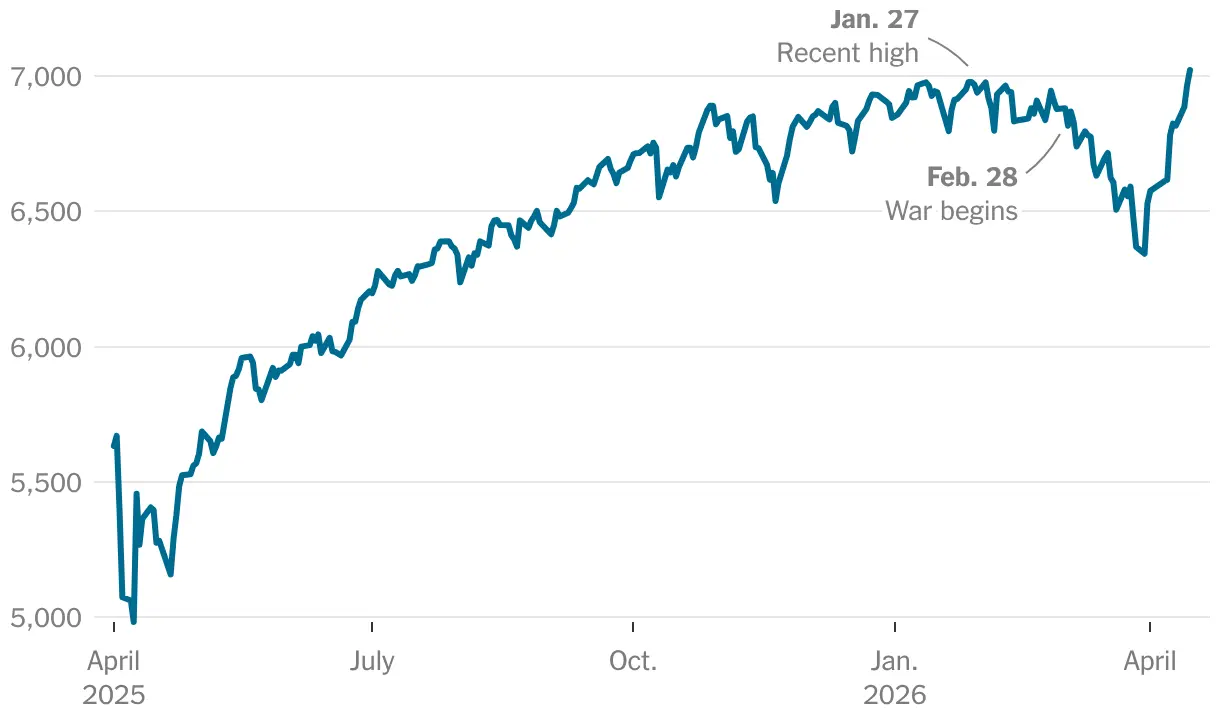
A Strong Surface, a Fragile Core
The S&P 500 has reached yet another record. The Nasdaq 100 continues an extraordinary run of gains. On the surface, the message from equity markets appears unequivocal: confidence is strong, momentum is intact, and investors are willing to look through uncertainty.
A closer examination suggests something more fragile.
Beneath the headline indices, market breadth has deteriorated, with more stocks declining than advancing even as benchmarks push higher. Such divergence is not merely technical—it speaks to the underlying quality of the advance. Historically, durable bull markets are characterized by wide participation. Narrow leadership, by contrast, often reflects selective conviction rather than systemic strength.
Concentration in Technology Leadership
At present, leadership is concentrated in a relatively small cohort of technology and AI-linked companies. Their influence is substantial enough to lift entire indices, masking weakness elsewhere.
Sectors more directly tied to economic activity—industrials, materials, and transportation—have lagged or declined. These segments tend to be more sensitive to shifts in demand and business conditions, and their underperformance raises legitimate questions about the depth of the current expansion.
Signals from Bonds and Currency Markets
Fixed income markets reinforce this more cautious interpretation. Yields have been moving higher across the curve, particularly at the long end. Rising yields increase the cost of capital and exert pressure on equity valuations, especially for growth-oriented companies.
At the same time, a weaker dollar over consecutive sessions suggests evolving global capital flows and shifting perceptions of relative economic strength. While not conclusive on its own, it contributes to a broader picture that is less uniformly positive than equity indices imply.
The Expanding Role of the AI Narrative
Artificial intelligence remains the dominant force shaping market sentiment. Its long-term potential is widely acknowledged, and in many respects, justified. However, current valuations appear to reflect not only optimism, but immediacy—pricing in outcomes that may take years to fully materialize.
Recent market behavior illustrates this dynamic. Companies with limited or newly adopted links to AI have experienced outsized valuation increases, driven largely by narrative rather than proven financial performance. This pattern is consistent with previous periods of technological enthusiasm, where expectations temporarily outpace execution.
Corporate Strategy: Efficiency Over Expansion
Corporate responses to current conditions further highlight the nature of the environment. Firms such as Snap Inc. have been rewarded for cost-cutting measures, including workforce reductions and operational streamlining.
While these actions may improve margins in the near term, they do not substitute for sustainable revenue growth. Markets that reward contraction as strongly as expansion may be signaling a shift in priorities—from growth to preservation.
Persistent Macro and Policy Risks
At the same time, several structural risks remain unresolved. Regulatory pressures are increasing, as demonstrated by developments involving Live Nation Entertainment. Trade tensions and tariff policies continue to affect global supply chains and cost structures.
Geopolitical uncertainty persists, while elevated debt levels—combined with rising yields—introduce additional constraints for both governments and corporations. These factors, individually manageable, collectively form a more complex and uncertain backdrop.
Momentum Versus Market Stability
What distinguishes the current environment is not a lack of awareness, but a willingness among investors to discount these risks. Momentum, supported by concentrated leadership, continues to drive the market higher.
However, such concentration also introduces vulnerability. When performance depends heavily on a limited number of companies, any disruption—whether from earnings, regulation, or valuation adjustments—can have an outsized effect on the broader market.
A Rally Built on Assumptions
The present rally is real, and its drivers are identifiable. However, its foundations are uneven. Current valuations in many areas reflect a convergence of favorable assumptions: resilient economic growth, stable policy conditions, and rapid realization of technological gains.
While such an outcome is possible, it is not guaranteed.
Investors would be well served to distinguish between strength in index performance and strength in underlying conditions. The two are not always aligned—and when they diverge, markets have a tendency to correct that imbalance, often abruptly.