




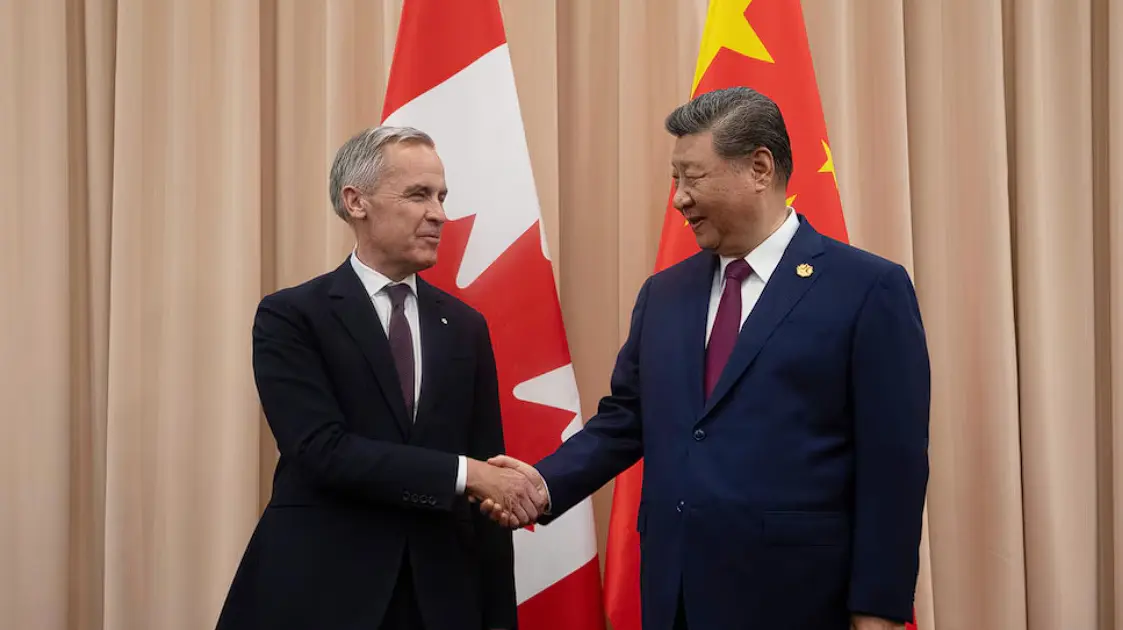
Canadian Prime Minister Mark Carney has moved to reset relations with China, announcing a new strategic partnership during a visit to Beijing that included tariff cuts and visa changes, and marking a significant pivot away from the United States at a time of deep strain within the Western alliance.
Standing alongside President Xi Jinping, Carney framed the shift as a pragmatic response to a changing global order, arguing that Canada’s relationship with China has become more predictable than its increasingly fraught ties with the Trump-led United States.
A Relationship in Deep Freeze
The visit was notable not only for its substance but for its symbolism. It was the first trip to China by a Canadian prime minister in nearly a decade, coming after years of diplomatic chill.
Relations soured sharply in 2018 when Canada arrested a Huawei executive in Vancouver on a U.S. warrant, prompting China to detain two Canadians. Although all three were released in a 2021 swap, ties failed to recover, and by 2024 concerns about Chinese interference in Canadian politics dominated domestic debate.
Against that backdrop, Carney’s Beijing trip marked a clear break.
What Carney and Xi Agreed
From March 1, 2026, Canada will allow the import of up to 49,000 Chinese electric vehicles at a reduced tariff rate of 6.1%, down from the 100% tariff imposed in 2024 at Washington’s urging.
In return, China will grant visa-free travel to Canadian tourists and lift or reduce tariffs on a range of Canadian agricultural and seafood products. Most significantly, China will remove its 100% tariff on Canadian canola meal and cut the tariff on canola seed from 85% to 15%.
Carney also announced an ambitious target to increase Canadian exports to China by 50% by 2030.
Beyond Tariffs: A Strategic Partnership
Beyond the immediate trade concessions, both leaders declared a broader strategic partnership spanning five areas: clean energy and climate competitiveness; expanded agricultural and food trade; a renewed commitment to multilateralism and global governance; cooperation on public security and safety; and stronger people-to-people and cultural ties.
The Economic Case for a Pivot
Economics is the most immediate driver of the reset. After Beijing imposed retaliatory tariffs in 2024, Chinese imports of Canadian goods fell by 10.4% in 2025. The impact on canola producers was particularly severe, effectively closing one of their most important markets.
Canadian canola exports to China were worth nearly $5 billion in 2024, making China the second-largest destination after the United States.
Ahead of the visit, Carney argued that Canada must reduce its dependence on a single trading partner. In an era of global trade disruption, he said, the country needs a more competitive, sustainable, and resilient economy — language widely understood as a reference to Canada’s reliance on the U.S. market.
A More Predictable Partner?
Carney has been unusually blunt in contrasting Beijing and Washington. He said talks with Chinese officials had been candid and consistent, producing a relationship that was more predictable and effective than Canada’s dealings with the United States.
Since early last year, the Trump administration has imposed tariffs on Canadian metals and automobiles and threatened additional measures, injecting uncertainty into the future of North American trade. In Carney’s telling, economic integration with the U.S., once Canada’s greatest strength, has become a vulnerability.
Signaling Independence from Washington
The pivot also carries a clear political message. Carney entered office in early 2025 amid escalating rhetoric from President Trump, who not only threatened tariffs but repeatedly questioned Canada’s sovereignty, at times suggesting it should become the 51st U.S. state.
Re-engaging China, alongside efforts to deepen ties with European partners such as the UK, France, and Germany, signals a more independent Canadian foreign policy.
Domestic and Strategic Risks
The strategy is not without risk. Lowering barriers to Chinese electric vehicles has drawn sharp criticism from Canada’s auto sector. Ontario Premier Doug Ford warned that Ottawa was opening the door to a flood of low-cost Chinese imports without securing corresponding investment in domestic manufacturing or supply chains.
Human rights concerns also loom large. Critics have noted the tension between Carney’s new partnership and his statement less than a year ago describing China as Canada’s greatest security threat.
Carney has responded by insisting that Canada’s “red lines” were clearly communicated to Xi, summing up his approach with a blunt assessment: “We take the world as it is, not as we wish it to be.”
A Global Trend Away from the U.S.
There is also the risk of retaliation from Washington, where the move is likely to be read as a direct challenge to U.S. efforts to contain China’s economic influence.
Yet Canada’s recalibration reflects a broader global trend. Over the past two decades, China has overtaken the United States as the largest trading partner for most countries worldwide.
Public opinion is shifting as well. A GlobeScan survey last year found rising preference for China as the world’s leading power across all 32 countries polled, including the United States, while support for American leadership declined. Pew Research has reported a similar erosion of pro-U.S. sentiment in high-income countries.
A Preview of What May Come
In that context, Carney’s China pivot may prove less an outlier than a preview. With strong domestic approval ratings, he could offer a template for other Western leaders seeking to loosen their dependence on Washington and adapt to a world in which U.S. dominance is no longer taken for granted.