




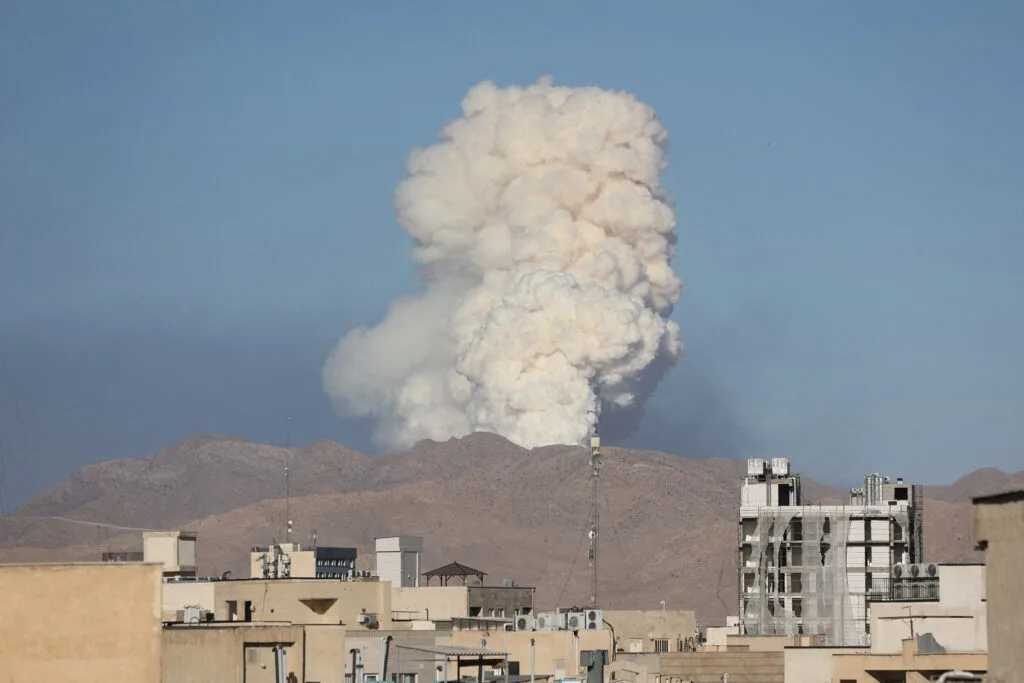
The Middle East awoke to a new and dangerous phase of conflict early Saturday as the United States and Israel launched coordinated strikes across Iran, targeting senior leadership figures and key military infrastructure. The scale and ambition of the operation — reportedly aimed not only at military degradation but at destabilizing Iran’s ruling system — mark a dramatic escalation in a region already on edge.
Israeli officials said the strikes hit command centers, missile facilities, and senior figures within the Islamic Revolutionary Guard Corps. Iranian state media has acknowledged attacks on multiple cities but has offered limited detail on casualties among senior leadership. Unconfirmed reports have circulated about the fate of Iran’s Supreme Leader, Ayatollah Ali Khamenei, though Tehran has not publicly clarified his status.
Washington and Jerusalem have framed the operation as necessary to prevent further regional destabilization. Israeli Prime Minister Benjamin Netanyahu described the strikes as “decisive action to neutralize existential threats.” U.S. President Donald Trump signaled that the campaign could continue in waves, suggesting the objective may extend beyond deterrence toward systemic change in Tehran.
Iran Strikes Back
Iran responded within hours, firing missiles toward Israeli territory and at U.S.-linked military sites in the Gulf. Explosions were reported near installations in Saudi Arabia, Qatar, and the United Arab Emirates. Some strikes reportedly damaged oil infrastructure, heightening fears of economic fallout far beyond the region.
Iranian officials vowed that the country would not fight alone. The Houthi movement in Yemen announced plans to resume attacks on Red Sea shipping routes, while Lebanon’s Hezbollah signaled readiness to escalate if Israel broadens its campaign.
Perhaps most consequential is Tehran’s reported move to restrict traffic through the Strait of Hormuz, a narrow waterway through which roughly a fifth of the world’s oil supply passes daily. Even partial disruption could trigger a spike in global energy prices, with ripple effects across Europe and Asia.
A War of Unequal Goals
The strategic objectives of the parties diverge sharply. For Washington and Jerusalem, success would likely mean the elimination of Iran’s senior leadership, destruction of its missile capabilities, and potentially the collapse of the current political order.
For Tehran, survival itself would constitute victory.
Iran’s leadership has long anticipated a decapitation-style attack and built redundant command structures designed to withstand the assassination of senior figures. Analysts note that even if top leaders are killed, successors — potentially from hardline elements within the Revolutionary Guard — could rapidly assume control.
Airpower can degrade military capacity, but history suggests it rarely topples regimes without organized opposition on the ground. The 2011 intervention in Libya succeeded only after rebels controlled significant territory before NATO’s decisive involvement. Iran presents a far more centralized and internally cohesive state apparatus.
Regional and Domestic Pressures
The conflict’s trajectory will depend in part on regional actors. Gulf states hosting U.S. bases face a precarious balance: publicly supporting Washington while absorbing retaliatory fire. Their tolerance for prolonged escalation may hinge on economic stability, particularly energy exports.
In the United States, public opinion could prove decisive. Polling before the strikes showed limited appetite for another major Middle Eastern war. If American casualties mount, domestic political pressure may constrain further escalation, especially ahead of congressional elections.
What Comes Next
The coming days will test whether this confrontation remains a high-intensity but geographically contained exchange — or spirals into a multi-front regional war.
If Iran intensifies proxy attacks and energy disruption while avoiding direct confrontation that would trigger overwhelming retaliation, it may seek to stretch the conflict into a war of attrition. Conversely, if U.S. and Israeli leaders believe rapid escalation can force collapse in Tehran, further strikes may follow quickly.
For now, the region stands at a volatile crossroads. The calculus on both sides appears rooted not just in military capability, but in endurance — and in which leadership believes it can outlast the other.
Whether this becomes a short, brutal campaign or the opening chapter of a broader regional war may depend less on the first strikes than on what neither side is yet willing to concede.